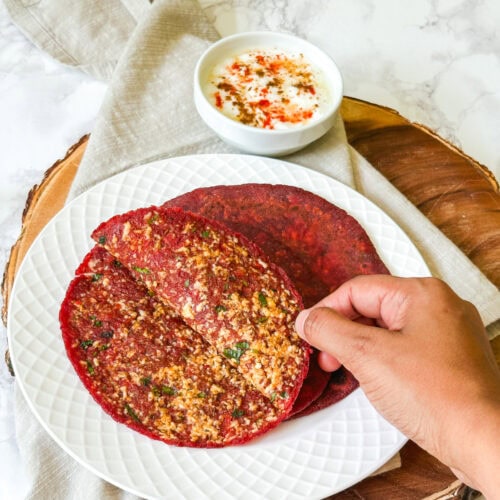
Beetroot Paratha Recipe (With Paneer Stuffing)
Try this paneer stuffed beetroot paratha recipe! These parathas are deliciously filling, perfect for lunchboxes or breakfast, and are kid-approved.
Servings 10 Paratha
Calories 181kcal
Ingredients
For The Dough:
- 2 cup Whole wheat flour (Chapati atta)
- ½ teaspoon Salt
- 1 teaspoon Roasted cumin powder
- 1 tablespoon Oil + more for cooking paratha
- 1 medium Beetroot ~ 1 ½ cups Chopped
- 1 inch Ginger chopped
- 1 teaspoon Lemon juice or Lime juice
- ⅓ cup Water
For The Stuffing:
- 250 grams Paneer grated
- 1 Green chili finely chopped
- 2-3 tablespoons Cilantro or coriander leaves
- 1 ½ teaspoons Red chili powder
- 1 teaspoon Coriander powder
- 1 ½ teaspoons Roasted cumin powder
- 1 teaspoon Amchur powder (dried mango powder)
- 1 teaspoon Chaat masala
- 1 ½ teaspoon Kasoori methi (Dried fenugreek leaves) crush before adding
- ½ teaspoon Salt or to taste
Instructions
Kneading Dough:
- Make a smooth puree from chopped beetroot, ginger, lemon juice, and water.
- Take atta in a bowl, add salt, roasted cumin powder, and oil. Add puree and start kneading dough. Add more water if required to make a smooth and soft dough.
- Smooth out the dough with a few drops of oil, cover, and let it rest for 10-15 minutes.
Making Stuffing:
- Take grated paneer in a large bowl. Add chopped green chili and cilantro.
- Also, add salt and spices (red chili powder, coriander powder, roasted cumin powder, amchur, chaat masala, and kasoori methi).
- Mix well and keep it aside.
Rolling & Cooking Beetroot Paratha:
- Divide the dough-ball into 10 equal portions and make smooth balls.
- Take one ball, flatten between your palms to make a disc, dust both sides lightly with flour, and start rolling into a 5-inch diameter circle.
- Place stuffing in the center. Gather the edges of the dough in the center, and pinch it to seal.
- Flatten the sealed disc lightly using your fingers, dust again with dry flour, and roll gently into a 7-8 inches diameter circle.
- Before you start rolling, place the tawa (skillet) on medium heat to preheat. Once hot place rolled paratha on it and cook for 30-40 seconds or until you see a few bubbles on the top surface and the bottom surface has a few brown spots.
- Flip it using a spatula and while another side is cooking apply oil on the top surface. Flip it and cook by pressing it lightly with a spatula.
- Again apply oil on the surface. Flip and cook another side similarly by pressing with a spatula.
- Once you see golden brown spots and no more doughy parts then remove the paratha from the tawa and keep it on a plate.
Notes
- The dough has to be smooth and soft. If it is hard and tight then you won’t be able to roll the paratha. Similarly, if it is too soft and sticky then again it’ll be hard to roll the paratha.
- The dough ball and the size of the stuffing portions both have to be the almost same size. This way you’ll get an equal amount of dough and stuffing in every bite.
- Make sure there are no air pockets while sealing the dough after stuffing. Those air pockets will pop while rolling paratha and start to break or tear from there.
Nutrition
Serving: 2PARATHA | Calories: 181kcal | Carbohydrates: 21g | Protein: 7g | Fat: 9g | Saturated Fat: 4g | Polyunsaturated Fat: 0.5g | Monounsaturated Fat: 1g | Cholesterol: 17mg | Sodium: 274mg | Potassium: 164mg | Fiber: 3g | Sugar: 2g | Vitamin A: 108IU | Vitamin C: 2mg | Calcium: 139mg | Iron: 1mg
